
How much the official WhatsApp costs (Meta)
Once you connect WhatsApp to the official API, the messages your shop sends out start being charged by Meta. It’s the doubt that stalls most migrations, and it has a short answer: you pay cents, only for the messages your shop starts, and Meta charges it directly on the card you registered there. This page explains the whole rule: what is free, what costs, how much, and what you can do today to spend less. To keep the number up and with a high limit, see also keeping your Meta account healthy.
How much will this cost me every month? #

Fear of the bill stalls the migration
The official WhatsApp bill fits any shop's cash flow: what scares people is not knowing the rule.
“Once you understand the billing rule, you stop postponing the migration.”
The question that stalls most migrations isn't technical, it's financial: "will I pay for every message my clients send me?". The shop owner pictures an unpredictable invoice at the end of the month and stays on the old channel, which is free but can go down at any moment.
The rule is simple and you control both sides of it: when the pet parent starts the conversation, everything is free, including all of your replies. You only pay when your shop starts the conversation, and then it's cents per message, charged directly by Meta on your card. The tecpet adds no fee on top, and on this page you see exactly which notifications cost money and which don't.
The golden rule: whoever starts the conversation decides who pays
Section titled “The golden rule: whoever starts the conversation decides who pays”Meta’s billing revolves around a single question: who sent the first message?
- The pet parent started: it’s free. They message you on WhatsApp, and from there you exchange as many messages as you want, with a human agent or with the AI, at no message cost.
- Your shop started: it’s paid. Every message leaving the system without the pet parent having brought it up (confirmation, reminder, pet is ready, follow up) costs cents.
The same goes for the phone app: in Coexistence mode, when you or your team pick up WhatsApp Business and send a message by hand, there is no charge, because the message left through the app and not through the API.
Billing is per message, not per conversation
Section titled “Billing is per message, not per conversation”This is confusion number one, and it costs money. Until mid 2025 Meta charged per conversation (a 24 hour window). Today billing is per message sent.
In practice, a single bath can generate more than one charge:
- Appointment confirmation (the day before): 1 billed message;
- Appointment reminder (on the day): 1 billed message;
- Service finished (“you can pick up your pet”): 1 billed message.
Same pet parent, same pet, same day: three billed messages. That’s why it pays to review which notifications your shop really needs on.
The two prices: utility and marketing
Section titled “The two prices: utility and marketing”Meta classifies each message template into a category, and the price changes with the category:
- Utility: a message about something the pet parent already hired or already has booked. Confirmation, reminder, pet received, pet ready, invoice notice. Costs around R$ 0.04 per message.
- Marketing: a message meant to create opportunity, with no service in progress. Follow up for a lapsed client, promotion, birthday gift, win back campaign. Costs around R$ 0.32 per message.
- Authentication: verification codes. Not used in a pet shop’s routine.
Both values are approximate and move with the dollar, because Meta’s price list is in dollars. Treat them as an order of magnitude, not a fixed price.
Careful: the words you choose set the price
Section titled “Careful: the words you choose set the price”The category isn’t picked at random, it’s inferred from the template’s text. If a utility notification’s text carries sales words, it gets classified as marketing and starts costing around eight times more.
The words that pull a message into marketing are the commercial ones: discount, promotion, promo, offer, coupon, you won, win, black. Words like code, verification, token classify the message as authentication.
An example of what to avoid: instead of “Tomorrow is Thor’s bath. Take the chance and get 10% off the hydration”, keep the confirmation clean (“Tomorrow is Thor’s bath, at 2pm. Can you confirm?”) and move the offer into a follow up message, which is already marketing by nature.
What does NOT generate a message charge
Section titled “What does NOT generate a message charge”- Any conversation the pet parent starts, and all of your replies inside it;
- Messages sent by hand from the WhatsApp Business app on the shop’s phone (Coexistence mode);
- The AI reading and processing. The artificial intelligence service is charged per service, inside your tecpet subscription (or through extra credits), and has nothing to do with the Meta bill. They are two separate bills: Meta charges per message sent, the AI is counted per service;
- Receiving messages, always.
Meta charges you, straight on your card
Section titled “Meta charges you, straight on your card”The credit card is registered in your Meta Business account, and it’s Meta that charges it. The tecpet does not resell messages and adds no fee on them: no summing up the month’s spend and passing it back with a margin. You pay Meta’s price, and that’s it.
Two practical consequences:
- The message invoice doesn’t come inside your tecpet subscription. They are two different payments, in different places;
- If the payment at Meta fails, sending stops. An expired or declined card, or an unpaid invoice, makes Meta pause the account, and automatic notifications stop going out. The system flags this in the diagnostic and in the WhatsApp notices.
It’s also worth knowing this cost isn’t the tecpet’s, it’s the channel’s: any platform connected to the official API (the tecpet or any other) generates the same Meta charge.
How to estimate your shop’s spend
Section titled “How to estimate your shop’s spend”The math is straightforward. For each month:
- Add up how many services your shop does per month;
- Multiply by the number of utility notifications turned on (each one is a message);
- Multiply the result by R$ 0.04;
- Add the marketing messages you intend to send (follow up, birthday, campaigns), multiplied by R$ 0.32.
Example of a shop with 250 services in a month and 3 utility notifications on: 250 x 3 x R$ 0.04 = R$ 30. Adding 100 follow up messages: 100 x R$ 0.32 = R$ 32. Approximate total: R$ 62 in the month.
On the tecpet website, on the plans page, there is a calculator that makes this estimate from your appointment and campaign volume.
Review your notifications before migrating
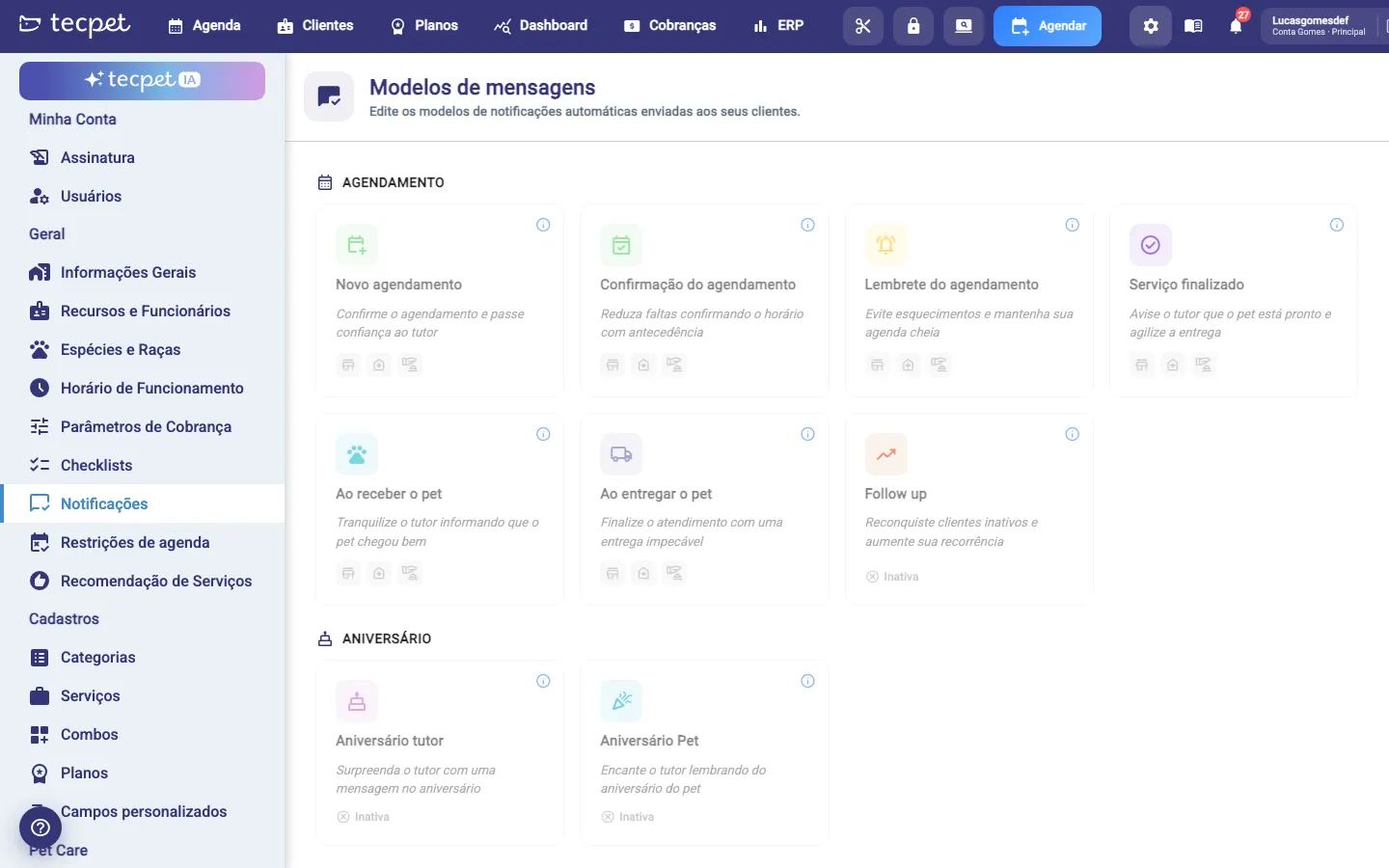
Section titled “Review your notifications before migrating”In Settings → General → Notifications you see all the shop’s automatic notifications, grouped by subject, with the Inactive ones marked. Every active card here becomes an approved template at Meta and a billed message when it fires.
What to look at before connecting:
- Turn on only what the shop actually uses. Confirmation and reminder usually earn every cent, because they cut no shows. Having both on when the booking is always same day can be double spend;
- Separate service messages from offers. Keep service texts clean of promotional words;
- Follow up and birthday are marketing. They are the priciest per message and, normally, the ones that bring the most return. Turn them on with intent, not out of inertia.
Where to see what was sent and what it cost
Section titled “Where to see what was sent and what it cost”Fine grained spend tracking lives at Meta, not in the system:
- In Meta Business (business.facebook.com), the Template manager shows each message template, its status (approved, in review, rejected, paused) and the sending metrics: how many messages went out, how many people clicked the link and how much was spent;
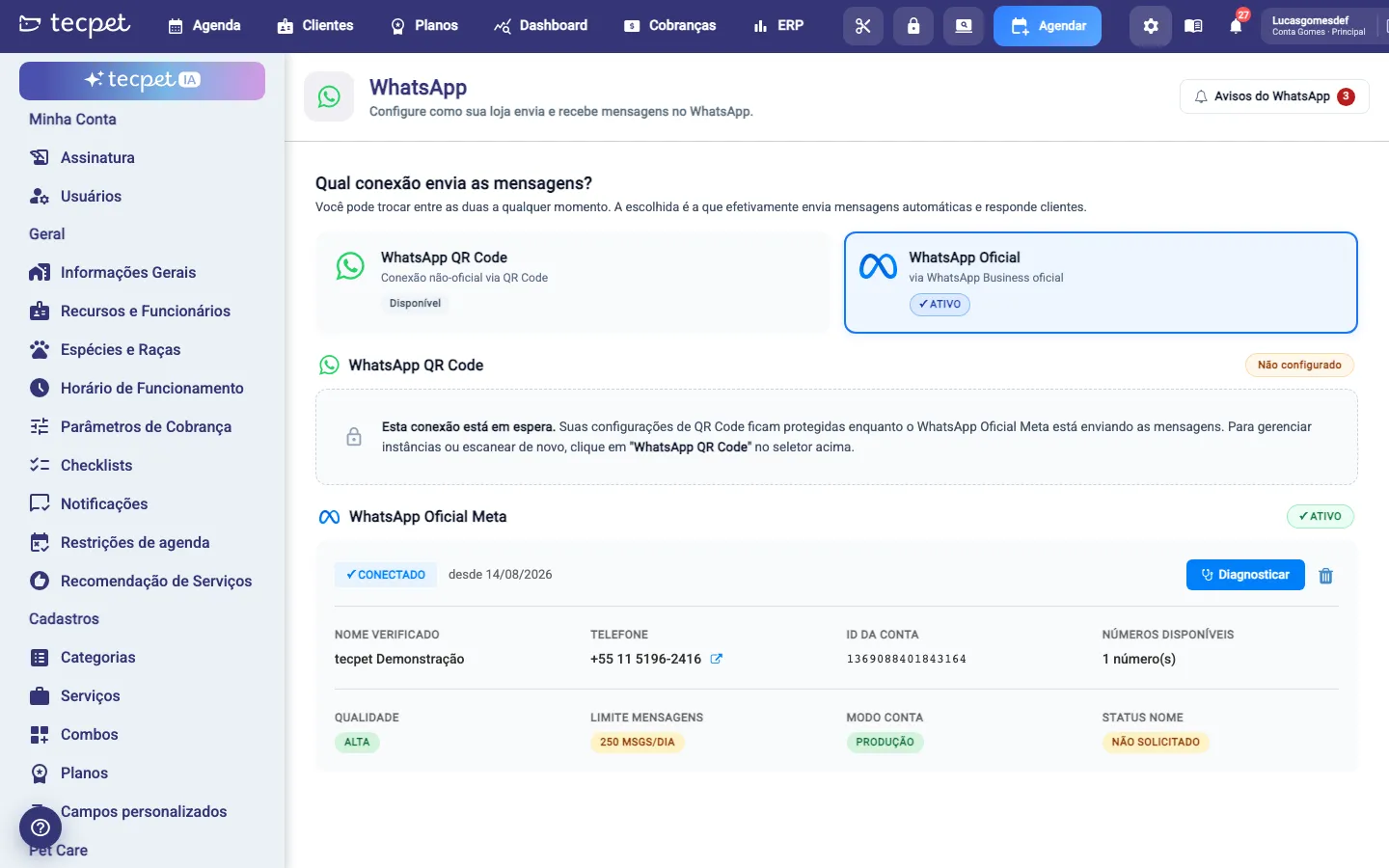
- In the tecpet system, the WhatsApp screen shows the messages per day limit and the quality of your number, which is what determines how much you can send. How to raise that limit is in keeping your Meta account healthy.
Is it worth it? A real example
Section titled “Is it worth it? A real example”An example the tecpet presented in a workshop with shop owners, to give an order of magnitude for the cost (it is a client’s result, and it varies with the operation):
- A win back campaign with 56 messages cost around R$ 25 in messages and brought 7 pet parents who had nothing booked, adding up to around R$ 838 in services. That’s roughly R$ 3.69 of message cost per recovered appointment;
- In another shop, message spend was around R$ 123 in the month against about R$ 3,171 in services coming from that channel, meaning message cost was around 4% of what the channel gave back.
The number that matters isn’t the absolute value, it’s the proportion: for most shops, monthly message spend lands in the tens of reais, less than one grooming session.